Vib-Ribbon: An oral history
Almost 27 years later, we round up the team behind NanaOn-Sha's procedurally generated playground to look at the legacy of PlayStation's wireframe rabbit.
Shawn Layden remembers when he first saw Vib-Ribbon. In 1999, Layden was vice president of Sony Computer Entertainment Europe, and was involved with deciding which Japanese games warranted release in Europe. Vib-Ribbon was still in development in Japan and wouldn't be finished for another few months. To bring it to Europe would involve the usual work of localization, testing, and converting a Japanese game for European television standards.
None of that was too troubling, though. The immediate problem was that Sony Europe's marketing department didn't want the game.
"We showed it to my colleagues in sales and marketing, and everybody hated it," Layden says. "But I thought, This is Masaya Matsuura. He made PaRappa the Rapper. We respect him.
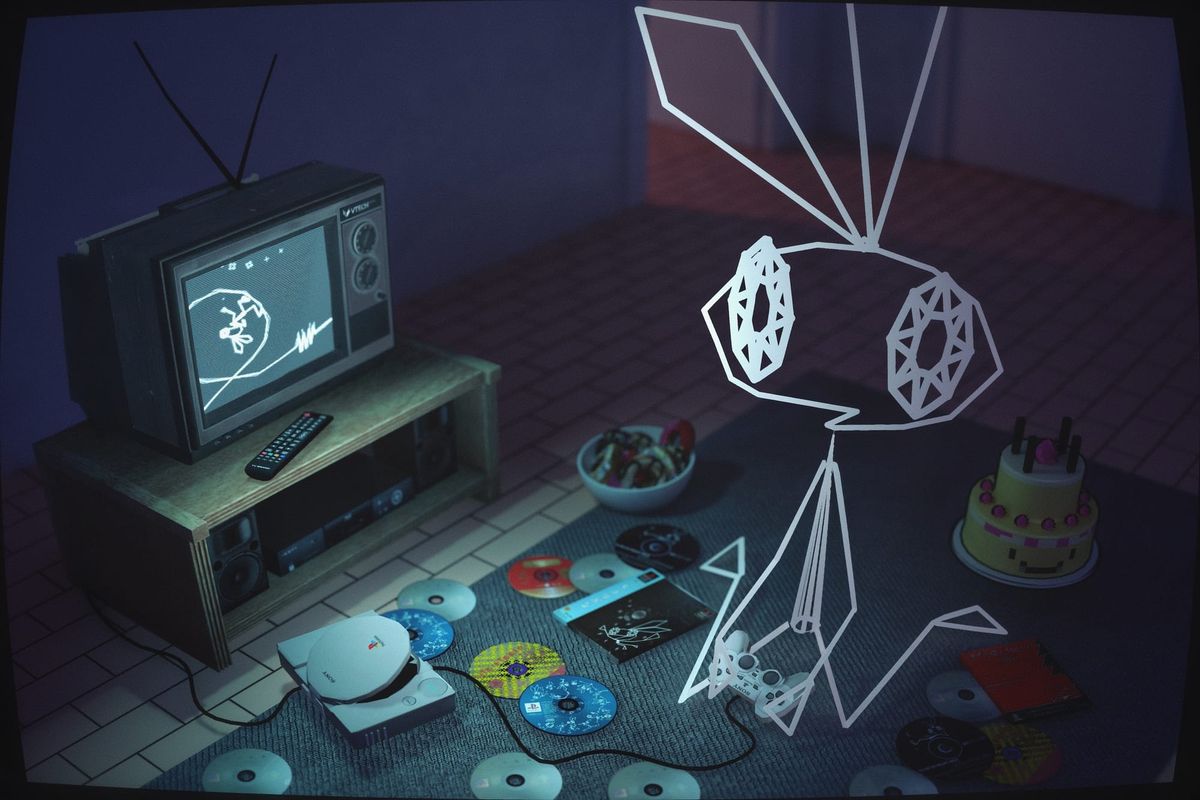
"But it was a tough sell. A strange game. Black and white, wireframe graphics, you put in your own music CD and it creates a different [stage] every time with different obstacles to get over, and if you do well you morph into a princess, and if you don't do well you turn into a worm. Now, how many financiers would write a check based on that description?"
With the PlayStation 2 coming in less than a year, according to Layden, it was also an odd time to release an experimental, visually restrained title for Sony's aging PlayStation. But there was something about Vib-Ribbon that he loved.
"I've got a soft spot for the weird, I suppose, and things I haven't seen before, and I thought it was crazy that the head of marketing said, 'No, we can't get behind this.' So, for the first and only time in my career, I decided this game deserved a little extra bump.
"I took the disc and I walked into the office of the president of Sony Computer Entertainment Europe, a gentleman named Chris Deering, and I said, 'Hey Chris, I gotta show you something. This is crazy!' And I put the game in his PlayStation dev kit and fired it up."
What appeared on screen was almost diametrically opposed to what many at Sony were interested in publishing. Vib-Ribbon made no concessions to realism, didn't bother replicating the latest blockbuster film, and wasn't interested in refining or modernizing game concepts from an earlier era.
Yet while Vib-Ribbon was visually simple, it was technically and aurally complex. The magic was that — alongside a catchy soundtrack by the three-person Japanese music group Laugh & Peace — players could create their own tracks by swapping the game disc for any audio CD. In this way, Vib-Ribbon became endlessly surprising and infinitely replayable.
"Chris plays it," Layden says, "and he's like, This is amazing! Who is this? Masaya Matsuura? Oh, that's the PaRappa guy. I know Matsuura.
"And I say, 'Chris, I'm thinking, you know, we could bring this to Europe.'
"And Chris says, 'Yeah! Bring it over.'
"And Chris' office was glass enclosed and sat right next to the marketing department in the offices in London, and I could see the head of marketing who had given me the thumbs-down literally 45 minutes earlier. And Chris opens the door and says to this guy, 'Hey, come here, you gotta see this!' And the marketing guy's eyes are shooting daggers [at me], but to his credit, he goes, 'Oh, yeah. Yes, very interesting.'
"I never pulled that trick again, because I know that's really out of school. But for that title, I felt, Okay, if I'm going to go off-piste, this is the time to do it."
Vib-Ribbon was a special game, and not just for Layden. It charted new territory for the rhythm game genre. It went on to become a cult favorite for its style and CD-swapping feature, which Sony patented. And the game's rabbit protagonist remains a fan art icon almost 27 years later.
Over the past nine months, we tracked down six people involved with Vib-Ribbon to look back at how it all began.