
How Harmonix made The Beatles: Rock Band
A new book excerpt reveals how Harmonix, MTV Games, and Electronic Arts teamed up with The Beatles for a rare video game collaboration.
Back in 2021, Blake Hester put together one of the great game industry oral histories when he wrote about Guitar Hero for Vice. The 30,000+-word feature dove into the series' history at Activision and the wild stories involved in that process.
Now he's turned it into a book, adding a second half covering Neversoft's Guitar Hero 3, Harmonix's Rock Band, and the rivalry that followed. To celebrate the launch, we have an excerpt below from the chapter "Tomorrow Never Knows," telling the story of how Harmonix made the deal for The Beatles: Rock Band — and how Yoko Ono's feedback impacted the game.
I should acknowledge my bias here — not only have I published two books with the publisher, Read-Only Memory, but I've worked extensively with the author (he even helped edit our Shadow of the Colossus oral history). Regardless, the book comes with my highest recommendation, and it's available now on Read-Only Memory's website.
If you're making music games, the ultimate goal is to secure a deal to include the tunes of The Beatles, arguably the most important group in recorded music history. And both Harmonix and Neversoft had long kept their eyes on that particular prize.
But this was in an era where The Beatles still weren't licensing out their music all that much — in fact, the'd only done it once before, to Cirque du Soleil. But a chance encounter led to a conversation. A conversation led to a pitch. And a pitch led to a long courting process. But then, against all odds, Harmonix pulled it off. They got the holy grail.
Thus started the long journey to turn the music of the four lads from Liverpool into The Beatles: Rock Band. The long and winding road from securing the rights to getting the game onto shelves did not pass without some choice words from Yoko Ono.
Eran Egozy (co-founder and CTO, Harmonix): There's very, very few bands who would deserve their own game. And this was one of them. And probably [Led] Zeppelin would be the other.
Alan Flores (lead designer, Neversoft): If I had a nickel for every time somebody said, "Why don't you get Led Zeppelin," I'd be a very rich man. Led Zeppelin doesn't have any interest in doing any game, that I'm aware of. Maybe they changed their mind now, I don't know, but they didn't wanna deal with Rock Band, they didn't wanna deal with us, they didn't wanna do it. The stories were that Jimmy Page wanted to do it but Robert Plant didn't.
Mark Scott (senior artist, Neversoft): They wanted Zeppelin so badly. I think it was Jimmy Page who said, "I'm not gonna cheapen our music by having it in Guitar Hero." But watch a fuckin' shampoo ad and they'll have a Zeppelin [song]. Oh, but you won't do Guitar Hero? OK, fuck you.
Alex Rigopulos (co-founder and CEO, Harmonix): One day, I got a call from Van Toffler, who was the president of MTV at the time. He had just come back from vacation where, for whatever reason, he had been hanging out with Dhani Harrison, [Beatles guitarist] George Harrison's son — as one does [laughs].
Michael Dornbrook (COO, Harmonix): He goes, as he put it, to dinner at "Bruce and Demi's" — Bruce Willis and Demi Moore, right? They're having dinner, and Olivia Harrison and Dhani are among the guests. And Olivia makes some comment about Dhani loving Guitar Hero, and Van Toffler says, "Oh, I just bought the company that made that game. Would you like to visit them?"
Alan Flores (lead designer, Neversoft): I mean, that was like — [laughs]. That was the big crown jewel. We all thought we were going to make a billion dollars making a Beatles game.
Joel Jewett (co-founder and president, Neversoft): So the holy grail of everything for me was fucking AC/DC. I'll give it to the guys at Harmonix. They got it. So, good job, guys. I wanted that one! And then, of course, The Beatles, yes.
[Harmonix put out an AC/DC-themed Track Pack for Rock Band in 2008 called AC/DC Live.]
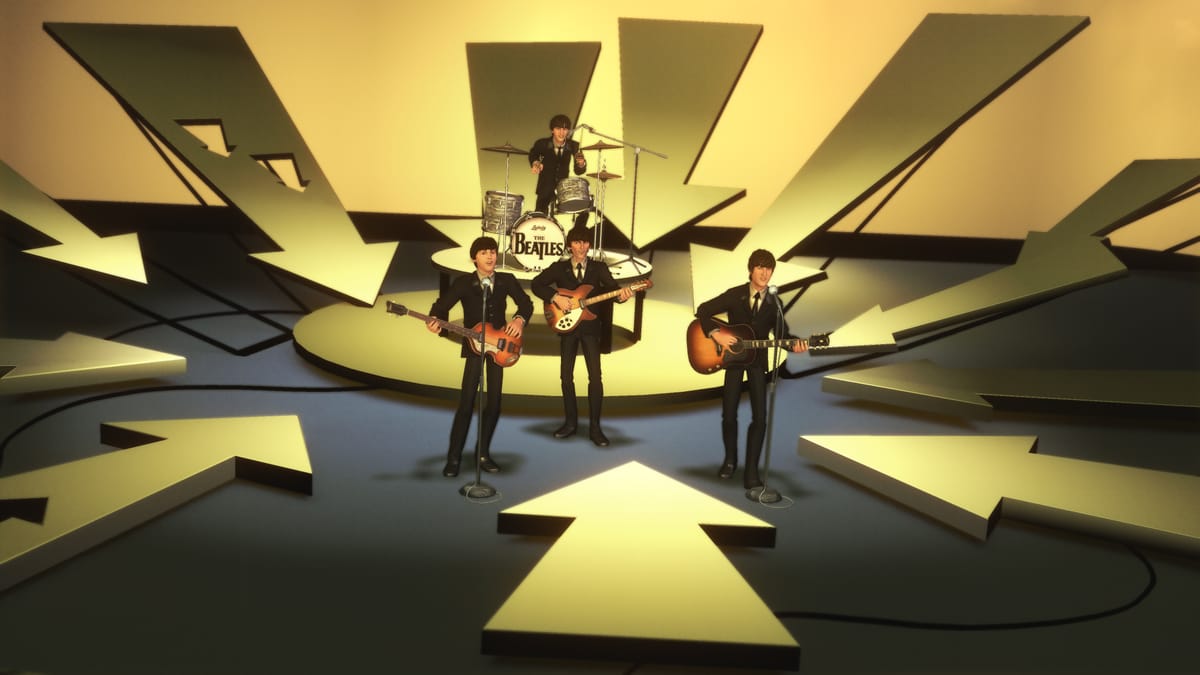
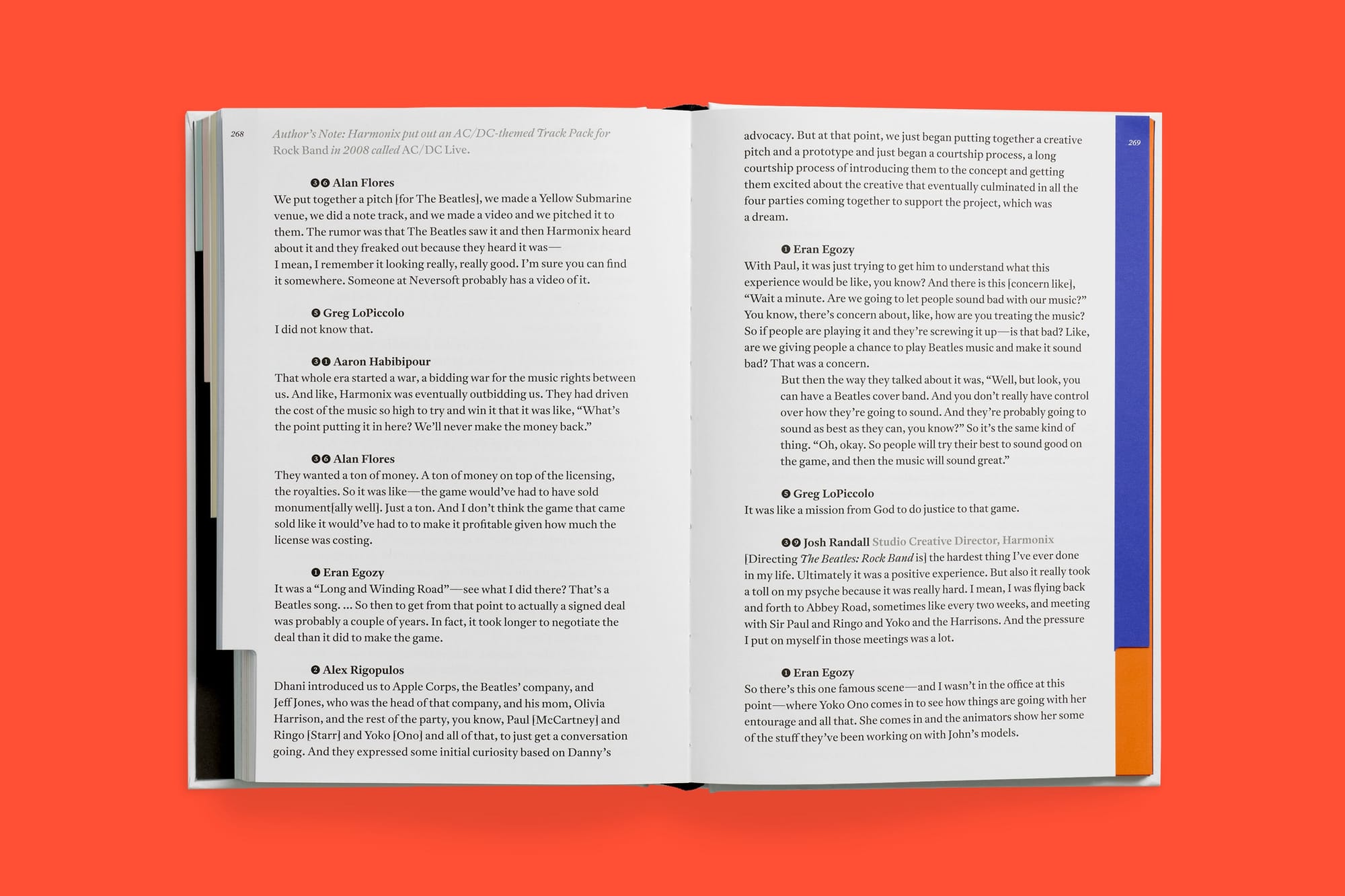
Alan Flores (lead designer, Neversoft): We put together a pitch [for The Beatles], we made a Yellow Submarine venue, we did a note track, and we made a video and we pitched it to them. The rumor was that The Beatles saw it and then Harmonix heard about it and they freaked out because they heard it was — I mean, I remember it looking really, really good. I'm sure you can find it somewhere. Someone at Neversoft probably has a video of it.
Greg LoPiccolo (project leader, Harmonix): I did not know that.
Aaron Habibipour (senior producer, Neversoft): That whole era started a war, a bidding war for the music rights between us. And like, Harmonix was eventually outbidding us. They had driven the cost of the music so high to try and win it that it was like, "What's the point putting it in here? We'll never make the money back."
Alan Flores (lead designer, Neversoft): They wanted a ton of money. A ton of money on top of the licensing, the royalties. So it was like — the game would've had to have sold monument[ally well]. Just a ton. And I don't think the game that came sold like it would've had to to make it profitable given how much the license was costing.
Eran Egozy (co-founder and CTO, Harmonix): It was a "Long and Winding Road" — see what I did there? That's a Beatles song. ... So then to get from that point to actually a signed deal was probably a couple of years. In fact, it took longer to negotiate the deal than it did to make the game.



The Oral History of Guitar Hero, Rock Band and the Music Game Boom is now available. | Images: Read-Only Memory
Alex Rigopulos (co-founder and CEO, Harmonix): Dhani introduced us to Apple Corps, the Beatles' company, and Jeff Jones, who was the head of that company, and his mom, Olivia Harrison, and the rest of the party, you know, Paul [McCartney] and Ringo [Starr] and Yoko [Ono] and all of that, to just get a conversation going. And they expressed some initial curiosity based on Danny's advocacy. But at that point, we ojust began putting together a creative pitch and a prototype and just began a courtship process, a long courtship process of introducing them to the concept and getting them excited about the creative that eventually culminated in all the four parties coming together to support the project, which was a dream.
Eran Egozy (co-founder and CTO, Harmonix): With Paul, it was just trying to get him to understand what this experience would be like, you know? And there is this [concern like], Wait a minute. Are we going to let people sound bad with our music? You know, there's concern about, like, how are you treating the music? So if people are playing it and they're screwing it up — is that bad? Like, are we giving people a chance to play Beatles music and make it sound bad? That was a concern.
But then the way they talked about it was, "Well, but look, you can have a Beatles cover band. And you don't really have control over how they're going to sound. And they're probably going to sound as best as they can, you know?" So it's the same kind of thing. "Oh, OK. So people will try their best to sound good on the game, and then the music will sound great."
Greg LoPiccolo (project leader, Harmonix): It was like a mission from God to do justice to that game.
Josh Randall (studio creative director, Harmonix): [Directing The Beatles: Rock Band is] the hardest thing I've ever done in my life. Ultimately it was a positive experience. But also it really took a toll on my psyche because it was really hard. I mean, I was flying back and forth to Abbey Road, sometimes like every two weeks, and meeting with Sir Paul and Ringo and Yoko and the Harrisons. And the pressure I put on myself in those meetings was a lot.
Eran Egozy (co-founder and CTO, Harmonix): So there's this one famous scene — and I wasn't in the office at this point — where Yoko Ono comes in to see how things are going with her entourage and all that. She comes in and the animators show her some of the stuff they've been working on with John's models.
Josh Randall (studio creative director, Harmonix): I would have meetings where it's like, "OK, Yoko, here is our depiction of your dead husband singing this super impassioned song ... What do you think?"
Eran Egozy (co-founder and CTO, Harmonix): And she hates it. She's like, "That looks stupid. He doesn't act like that."
Josh Randall (studio creative director, Harmonix): The thing is, she was totally right. I don't know how this happened — I mean, I know how it happens, because videogames are hard. John was less developed by the time Yoko came to visit us, compared to some of the other band members. He looked like a mopey shoe-gazer guy. He was like this, looking down at the ground. We hadn't figured out how to depict his personality. And so in this meeting, she's like, "No, he was a tough guy. He could be mean. Like, that's not him. Who is this guy?"
Alex Rigopulos (co-founder and CEO, Harmonix): She was holding the development team to a very high standard with respect to how John was represented in the game — as she should have. She was a tough customer — as she should have been. You know, this was an important project, and we actually were grateful for that level of scrutiny. I mean, she actually made the effort to come all the way up to Cambridge and spend a day in the studio, sitting with our artists focused on minute details of the face modeling and the animations and everything else.
So, as you can imagine, the artists and animators are all, like, sweating bullets having to justify the work to Yoko. But she was right! Her criticisms were spot on. And while it was stressful for us, we were really grateful to have her looking over our shoulder at the work, making sure we were doing it well.
Josh Randall (studio creative director, Harmonix): I was like, "Well, can we maybe just look at some footage together and talk about it?" And so I put on footage of Shea Stadium, and immediately there's John Lennon standing at the front of the stage looking down his nose at everyone, like balls out rock and roll God not giving a fuck. We saw that, and me and our animation director just had this mind meld. We looked at each other and Chris, the animation director, clicked on the back of John's spine [and lifted him up a bit]. And she's like, "That's John. There he is."
Eran Egozy (co-founder and CTO, Harmonix): Oh, man. Like, I remember when we got Beatles multitrack masters. OK? Of course, I was a huge Beatles fan, so I kind of know all their songs. I go into ... the studio, and someone's like, "Hey, listen to this," and they're playing me the isolated Beatles vocals. And I got shivers, you know? Like, I wouldn't say I was in tears, but it was super emotional. I was definitely like — I felt like tingles in my spine when I was listening to these vocal tracks on their own. It was amazing.
Alex Rigopulos (co-founder and CEO, Harmonix): We were working in Abbey Road Studios with Giles Martin and just listening to the original tapes from these sessions. Not just the songs which are released, but the complete tapes, which has the banter between the takes. And that was actually, for me, the most goosebump-generating, right? Like, they finish a take, and then the band just immediately starts ribbing each other about something — someone messed up or what they want to do differently or just about nothing in particular. They'll finish this incredible take of the song and then just start talking about something that hasn't nothing to do with anything. So just having that of audio peek behind the curtain [into] the inner lives of the musicians as they're working on this material was really stimulating.
Josh Randall (studio creative director, Harmonix): I mean, I'm so proud of it. And I think it does that thing. It"s like a vehicle for The Beatles music to sink deeper into people's consciousness I feel like. It's like an alternate delivery system. I feel like we did the work to really take their spirit and their music and bring it to this other realm that still allowed the spark that made them magic, to have that spark reach people through a videogame. I think we were able to find that spark and pass it through this crazy system of technology and have it still present. Anytime I talk to people, it's like, "That's my favorite music game. I cry when I play that game. It's so beautiful." We were able to really create an emotional response in a video game.